
Congress Wants to See Your ID Before Using the Internet
BJ talks with Jibran Ludwig, Policy Strategist at Fight for the Future about The Guard Act, which would basically age-gate the Internet.


The following transcript has been edited for brevity and clarity.
BJ Mendelson, co-producer of Stupid Sexy Privacy: Hello everyone, this is something new for Stupid Sexy Privacy that we'll be doing once, How to Protect Yourself from Fascists and Weirdos comes out. We're looking at the end of May. Don't hold me to that. But the book is coming. It's coming out. And what that means is, I suddenly have a lot of free time on my hands. That means, I'm going to be digging into some of these big bills that are out there that affect our privacy, security, and anonymity.
So I'm joined today with a special guest from Fight for the Future, who is going to talk about one such bill. Would you like to take a moment to introduce yourself?
Jibran Ludwig, Policy Strategist at Fight For The Future: Yeah, hi, I'm Jibran Ludwig. I am policy strategist at Fight for the Future and my job basically involves trying to make sure we are efficiently yelling at Congress and tracking legislation.
BJ Mendelson: I like that. "Efficiently yelling at Congress" is a good way to put it. We've had Lia Holland on Stupid Sexy Privacy's main podcasts, but for people who missed that episode — you can listen to it right here — can you tell us a little bit about Fight for the Future?
Jibran Ludwig: We are a advocacy organization that works at the intersection of human rights and technology. And as tech has slowly crept into every aspect of life, that has meant that we've had an ever-expanding number of campaigns to work on.
In the last four or five months, we've been very heavily focused on anti-surveillance issues, particularly related to ICE. That's always been an important part of our work, but that's just been like a big, like everyone's been working on it.
We've also done a lot of work around free expression. I spent the better part of the year before working on pushing back against some of these kids online safety bills like the Kids Online Safety Act (KOSA) that would threaten free expression online. So yeah, we do a pretty wide range of stuff. And I get to do a little bit of everything because my work is about What's the policy angle? What's the Hill doing about this? And how do we, respond to threats from the Hill and where are there opportunities to maybe push them?
BJ: As I started working on the book, the online ID checks is something that started to creep up as we were getting ready to complete it. And it looks like it's beginning to develop into a serious problem. So I'm hoping you can tell us where is this push coming from for all these different online ID checks? And then tell us a little bit about this current bill.
Jibran: Absolutely. Yeah, online ID checks, as you said, are something that went from being kind of a distant threat to suddenly being implemented in many countries across the world and increasingly many states in the US. The broad impetus behind online ID checks is the idea that we need to age segregate the internet, that there are parts of the internet or types of content that are fundamentally inappropriate to minors or harmful to them. And it is important to separate minors from them. And to do that, everyone will need to submit to online ID checks.
So that's the broad theory, right? That we need to age segregate the Internet. And the way to do this is to subject everyone to online ID checks. Sometimes literally ID checks, like you have to upload your government ID. Sometimes the laws allow for things like facial recognition to try to like estimate your age, which is creepy and bad in its own way. But all of it is, I would say, where it's really getting its momentum to actually create laws comes from advocacy around keeping kids safe online. That's really the broad social movement cover for online ID checks.
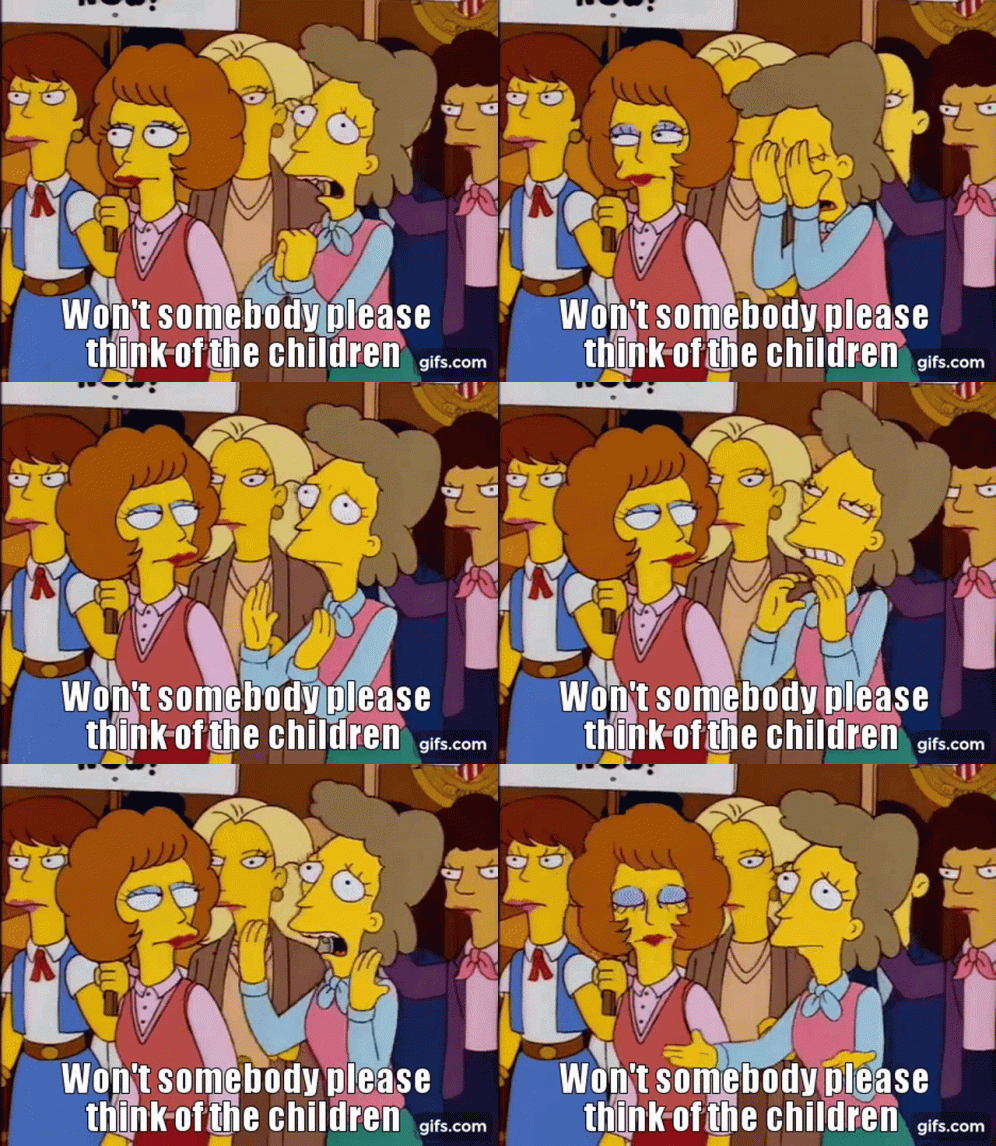
BJ: It sort of reminds me of Helen Lovejoy on The Simpsons. I'm showing my age with that reference, but, you know, "won't somebody please think of the children."
I want to stress this point because this is something that we've been asked, which is, well, what do you mean when you say online ID check? So quite literally, you are scanning, for example, your driver's license and then sending it to probably a third party software provider who is going to scan that ID and sort of give you the thumbs up and thumbs down and you have no idea what they're going to do with that data once they have it.
Do I have that right?
Jibran: Yeah, that's exactly right. So there was a high profile example of this actually. Discord rolled out, I think, test of online ID checks. It might have been just in the UK specifically. And they were using a third party to conduct them. And that third party got hacked. And 70,000 people had images of their photo, like their government IDs, leaked. And that is the kind of thing that would really expect to be pretty normal if there are a lot of companies that have to be holding this sensitive data.
Data breaches happen all the time. I think people maybe underestimate how much. There are parts of the internet that are very secure. There are aspects of it that are very secure. End to End encryption is very effective. And data breaches are just a fact of life on the internet. And if you put your data out there, you give it to a company, it may very well end up in the hands of anyone, right?
BJ: Right. Yeah, we call those people fascists and weirdos, right? That's our catchall. And one of the things we stressed in the book was that it's not innocuous that they have this data. It could be used in the form of maybe feeding data into an algorithm to manipulate you into trying to push you into thinking and feeling certain things. So it's not innocent that these things happen all the time. It's every time a data breach happens that information could be used against you. Whether by a fascist or by the billionaires and millionaires who fund them by, for example, adjusting prices on your car insurance or maybe your groceries, depending on how much information they have.
Jibran: Absolutely. And to me, the thing that is scariest about all of this, there's a baseline level of like, if this is out there, identity theft becomes a lot easier. There's just a huge, there's just a huge risk there. But the thing that I'm most scared of is that it sets us up for being in a world where all of your browsing activity is tied to your government ID. And that means that your government can potentially figure out everything you look at. Governments cannot be trusted with that, I think. As we've seen time and time again.
And, and I think people sometimes take the attitude of, 'well, if I've got nothing to hide, then I've got nothing to fear.' But the reality is, like, very quickly, governments can shift from, well, we're doing this to combat terrorism, which is in and of itself problematic.
But let's just set that aside for now. Let's say they've decided that like, wokeness is now going to be a thing that they use to blast your people. Right. And it's like, okay. If what is innocuous one year can suddenly land you in trouble, or even if it doesn't, end up with you getting like arrested, right. It's the kind of thing that can be used to deny you government benefits, like immigration benefits or any number of things. There's a huge amount of vulnerability that we have when there's really no privacy.
BJ: That's right. Yeah, the example we used in the book was abortion. If you live in, we don't call them Red states, we call them occupied states. There's states where you can vote, mostly without a problem, and states where you can't. Guess which one the occupied ones are?
But if you live in an occupied state, for example, if abortion is made illegal, then if you are viewing content about an abortion, well, guess what? The government says that's now illegal and they can take action against you, which is deeply concerning.
That brings me to this Guard Act. Because I think so far, at least at the time that we were researching the book, it appeared in the United States specifically that this was something happening on the state level, particularly among the occupied states. But now with the Guard Act, this looks like something on the federal level. Can you tell us a bit about this, Bill?
Jibran: Yeah, so the Guard Act is not the first online ID check mandate we've seen being considered by Congress. But I think it's notable for a couple of reasons. First of all, it is extremely sweeping in its scope, much more so than most of the other bills that are being considered right now. The other aspect that's deeply concerning is that it doesn't actually look like a universal online ID check mandate.
And so it's not being talked about as one, right? It's being discussed as this very narrow bill targeting AI chatbots. And I mean, look, I have no love of AI chatbots personally, but because of that, Because the target of this bill is something that's like pretty unpopular. At the very least, I think most people have ambiguous feelings about it, like, well, maybe whatever, right? Like, people are more likely to go along with that. And the debate that's happening in Congress over this bill just flatly is not viewing it for what it is. So, you know, I watched the hearing yesterday and then I this I don't know if you've you have it, but there's an amended version that was made available after the hearing. They did an amendment in the form of substitution. So they basically just said the bill was a mess. We've rewritten it and that's what we're moving forward.
So yeah, they basically have rewritten the bill, but not in ways that really address the problems with it. So there are a couple ... I think the biggest problem or the key issue that causes everything else to come into focus: It is their definition of a covered entity. So frequently in in tech legislation, there's an attempt to be specific about the kinds of entities that actually have to comply with some regulation, which is generally wise for a variety of reasons. Including the fact that like, it's good for companies and for academic institutions and nonprofits to know if they have to actually care about a regulation at all. It's also good to know the consequence of this. If you're you're unclear about who's covered. People who should be complying, maybe won't be.
And on the flip side, in a case like this, where the penalties for noncompliance are extremely harsh, if you poorly define who's covered, you create a situation where anyone who might plausibly be covered has a very strong financial incentive to adopt those regulations. So that's the really concerning thing that's happening here. So first of all, there are the penalties per violation here are $250,000 per violation, which to be clear, likely means per minor you fail to age verify. If you weren't doing it, it would be the individual that is coming on there.
That could be a violation.
It might even be per access. It's ambiguous as written, but COPPA fines are assessed in a similar manner and can get absolutely massive. And this is about five times the size of a COPPA fine.
BJ: And you're referring to, for people who don't know, the Children's Online Privacy Protection Act, is that right?
Jibran: That's that's right. So, the covered entities, I'm just going to read you the full definition. The term covered entity "means any person who makes publicly available to end consumers an artificial intelligence chat." (The full text of the Guard Act can be found here.)
That is incredibly vague.
So a person in this case can mean like a corporation, right? We're talking about a legal person here, not necessarily an individual. That's a fine. The issue here is "makes a publicly available to end consumers." So that covers an AI company that's operating a chatbot. But it also, I think, pretty clearly would cover an internet service provider or other providers of Internet infrastructure, they are making available. Like making this stuff publicly available. And so they would, at the very least, have to consider whether this applies to them. And I think on a basic reading of this text, it does apply to them. And if we think of it a little bit further ahead. There's a reason why this bill tries to define an AI chatbot and is pretty broad about it; and that's probably correct on some level. If we think about what an AI chatbot is, I think the first thing we all think of is like a text message interface. But that's not the only way that people engage with AI chatbots. Grok really famously can reply to people in the form of tweets and can receive inputs in the form of tweets. And so clearly X is making available, like making publicly available an AI chatbot. I don't think anyone would really disagree with that.
But what that means, and now X is making it available in two senses there, right? One, because they actually operate the chatbot. But also, if someone, to take the example of Blue Sky, if someone were to create an account on Blue Sky. And then set it up such that it responds to people with inputs, with the outputs of an LLM chatbot, I think Blue Sky would be reasonably covered by this. They are making available to end consumers an artificial intelligence chatbot, even if they're not operating it. It doesn't say they have to own it or operate, it just says "make available to." And so this means that, and to be clear, every covered entity needs to impose an online ID check to anyone who might be interacting, anyone who wants to interact with an AI chatbot. [Emphasis added.]
Now, if you're on BlueSky, hypothetically, anyone who logs onto the website at all may be interacting with an AI chatbot. There's no knowledge standard here. You don't have to know that they might be interacting, like that they are interacting with a chatbot or that they might be. That's not specified in this law or in this bill. yeah, so that that is incredibly broad.
So the concern that I have is that this this bill ... It appears to be very narrow. It says, this is about AI chatbots. But it's actually constructed in such a way that it would apply to practically every social media platform for sure, even those that don't operate their own chatbots. Potentially to anyone with like a blog and a comment section in that blog. And certainly to like infrastructure providers, like internet service providers, app stores. Everyone would have to engage in this age verification and that.
BJ: To that point, when you use Riverside, you have to use Google Chrome. They push you to Chrome. I looked over in the corner and it says, "Ask Gemini" at the top right of the Chrome browser. So would that include browsers like Chrome or Firefox or even DuckDuckGo's which, has a search assistant built into it?
Jibran: Yeah, I think the answer is yes. There is an attempt in the bill to distinguish between an AI chatbot and an AI companion. But again, there is ...
The key thing to know about this is that the bill distinguishes between AI chatbots on the one hand and AI companions. It regulates both, but it actually outright bans minors from interacting with AI companions, which is pretty important because the definition of a companion or what distinguishes a companion from any other chatbot is pretty loose.
BJ: It just, sounds like another one of those things that is intentionally vague. So I want to make sure that I have the bill identified correctly for readers who want to look it up. So it's 3062, the Guard Act, and it was introduced by Josh Hawley. Is that right? Like, do I have to correct bill?
Jibra: Yep, that is it.
BJ: I'm looking at the supporters of the bill and I see a lot of Democrats. And what I was going to say was, [the bill], it's kind of vague; and it just strikes me as another one of these vague bills that's pushed by the far right or MAGA Republicans. People who, want these things to be intentionally vague so that they could use it, for example, to prosecute the Southern Poverty Law Center under some vague pretense, just as a hypothetical, right?
I can go on.
But I've noticed, and this is where I'd like to ask for your help, there's a number of Democrats supporting this bill, some of whom surprise me and some don't.
So for example, I'm surprised to see Sheldon Whitehouse on there. I'm not at all surprised to see Kirsten Gillibrand, who's my senator and who voted yes on the Genius Act. So she seems to enjoy supporting these bills, but there's a lot of Democrats here that are supporting it too.
Is the vagueness designed to elicit bipartisan support or is the vagueness part of this larger MAGA project. Or maybe it's both?
Jibran: That's a good question. I honestly don't have a super strong answer for you here. I think, honestly, I think the biggest part of it is that writing tech bills is hard and Congress is both lazy and lacking in technical expertise. There were some members that are up to it, [such as] Ron Wyden; and there are plenty of staff who have a lot of technical expertise. But there are a shocking number of these bills that are just really poorly drafted. And this one kind of sat by the wayside for like six months and then suddenly is being pushed. And so I think part of it may be a lack of development, but ... You know, I think it's notable that these issues were not resolved, nor were they even discussed in the hearing. Right. I mean, they were a couple of of, I guess, critical comments from senators. Ted Cruz read the bill and thought that it banned minors from using chatbots altogether. And Hawley said, no, no, no, no, no, it's only these AI companions. I think Ted Cruz is probably right, actually. It probably...
BJ: That's the first time I've ever heard anyone ever say that. Please go on.
Jibran: Yeah, no, it's rare, but I have said that a few times. Yeah, no, no. We sell a Ted Cruz's tears mug on our website... So we're no fans of Ted Cruz, but he is occasionally annoyingly correct. And in this case, I think he's right. I think the key problem here is it's trying to specify what kind of behavior the chatbot engages in as like what distinguishes a chatbot from a companion.
The problem is it's hard to control these LLMs in that sort of fine grained of a way. Like I know some people who do red teaming on AI, like internal, like, okay, let's see all the messed up things we can get our chatbots to do. And it is horrifying.
Like it's really, really difficult to put in these guardrails. It's really difficult to prevent them from being ... users can get them to do a lot of things they're not supposed to do. Potentially quite easily. And so the problem is, right, if you are, for example, like most companies these days, like a lot of big companies just have a customer service chatbot on their website. And they sort of try in this bill to be like, well, if it can only answer things in like a limited scope or some of the answers are predetermined, but the reality is you can get those chatbots to spit out a lot of stuff they're not supposed to quite easily. And companies know this. They're not ignorant to this fact. And so there is a knowledge standard in part of the bill applying to some like really specific violations within it. And in that case, I think basically any company knows that any chatbot can go off the rails. And so they will have to probably just ban all minors from using anything that's like a chatbot.
So to get back to your question ... Would those search companions qualify? Probably. I, I think they likely would. Part of the answer is no, because it's vaguely written. but yeah, to get, to get back to the question about like, is this vagueness intentional? I think that's a good point that sometimes vagueness is about trying to get bipartisan support. I think sometimes it's just sloppiness, and sometimes it is malicious. I'm not sure what's going on in this case.
As someone from Missouri, I don't have any particular love of Josh Hawley.
BJ: Yes, that was my next thing. Given who the sponsor is, this is a guy who raised his fist to insurrectionists [on January 6th] and then ran away. Then historically, he has been a critic of Big Tech, but doesn't really walk the walk. He talks a good game. So I was curious to see your thoughts on Hawley being the guy who is sort of bringing this to the floor.
Jibran: Hawley is strange. I briefly interned on the Hill for Congresswoman Cori Bush, she's also, you know, a representative from Missouri. Was. And in my time there, we actually had a very quite productive relationship with Hawley's office. were they were working together. On this bill to do some like nuclear waste cleanup related to the Manhattan Project. And his office was actually like quite cooperative, surprisingly so. Pleasant to work with, relatively speaking. And so it's, yeah, it's weird. My impression, I'll just say, I think unfortunately, there is a fascist threat here, but I don't think, unfortunately, I don't think that's all that's pushing this forward, right? the big problem, I think is that a lot of this stuff is quite bipartisan and a lot of this stuff is quite popular.
Like there are very influential parents groups that are pushing for a lot of this. And the politics are really rough for members of Congress. And even the ones who are like, know that these bills are bad. One thing we've actually heard before, like explicitly, there was a KOSA hearing like a year and a half ago. And I remember, there were several Republicans who came and spoke and basically said it was the House hearing specifically. Dan Crenshaw was one of them. There's a couple of others. And they basically said, look, this bill that we're pushing is unconstitutional and it's going to get struck down by the courts. And we're going to have to come back here in a couple of years and pass something else. Let's just do it anyway. They were all supporting it. They were like, we need to do this because we're getting so much pressure from the parents groups. We have to do something, even if that thing is something we all know is going to get struck down. And this bill [Guard Act] might be another example of that.
I'm not a lawyer. I work with lawyers, but I'm not a lawyer. I do think based on what I've heard from other people about this, that the definition of AI companion here is probably blatantly a violation of the first amendment. That it is it is a prohibition on speech in this very weird specific way. That it is this bill that would probably be struck down.
BJ: That's something I wanted to ask you. I'm thinking about Citizens United, right? Where they're saying, where they essentially granted liberty rights to corporations, which would include speech. And it seems, I know it sounds silly to say out loud, but if you're limiting people's ability to get to a chat bot you are actually eliminating the company's freedom of speech, right? To offer you this chat bot, like you're restricting this conversation that could occur, because it's a conversational computer [interface.]
Jibran: Sorry, can I just briefly say: I do want to note though it's not just companies right like this applies to private individuals. If you make a like novelty chat bot and according to this bill you could face criminal penalties if you make it publicly available and don't impose age verification. It's that that's part of what's going on here too. But yeah, absolutely to everything you just said. [Emphasis Added.]
BJ: I've been recording a lot of interviews about New York for All and how we have a democratic trifecta in New York and they refuse to pass it. And the frustration that exists of ...
What do you do when you're against the bill, or for a bill, and all of your representatives, whether they're a Democrat or Republican, or on the other side of the fence from you.
So I mentioned Kirsten Gillibrand as an example here of my senator, right, supporting this bill. What can people do who are listening to this conversation, who have concerns about the Guard Act?
Jibran: I think a lot of people kind of brush this off. But like, I've worked in a congressional office before. They care about what people say. Like if you're a constituent and you reach out to your member of Congress and you tell them what you think about something that gets recorded and they do care. The challenge is
They also care about what constituents who disagree with you say, right? And one of the things that's happening here is that there are some very well organized parents groups who show up to every one of these hearings and are there constantly telling really horrible stories about things that happen to their kids. And that is, I think, on a human level, very difficult for members of Congress to ignore. And so I think one of the things that is like most
critical in this moment is to make sure, A, that you are making your voice heard on issues you care about, just like in general. think that's good. That's important. But also, specifically, I think that we need to be foregrounding what is at stake here. What happens on the Hill a lot is that real concrete specific stories of tragedies are weighed against pretty much nothing but you know people in advocacy orgs like mine saying 'hey We're worried that this bad thing could happen'; and when they hear from us, you know some offices will listen to us but they care far more to hear it from constituents and so either, reach out to your elected officials or even potentially more powerfully, if you have ideas about this, beliefs about this, that are strongly held and you feel moved to write or create art like genuinely ... I think part of what we need to combat this, this moment of rising fascism is a both a clarity about what is at stake that can, I think often only be expressed through creative media.
Or a vision for the kind of world we want to live in. So, you know, if you believe in an Internet, it's not dominated by tech companies that don't care about our privacy and where, you know, the government is not able to track your every every page view. Then I think it's it's now is the time to stand up and say something about that in whatever way it calls to you.
BJ: The big thing here is I'm thinking about like the parents rights groups argument, right? Which is, "ChatGPT told our teenage son to kill themselves." What is Fights position on the AI chat models in general with kids accessing them?
Because I feel like that that's part of this conversation, right? Like we're saying the Guard Act is bad, but I know that the parents are immediately going to say, all right, well, we still need to protect our kids. So, what is the response made to that?
Jibran: Yeah, that's a little bit complicated and I'm a bit hesitant to speak for the org as a whole on this because we're a pretty diverse org, and people have differing views on AI in our org.
I think when it comes to a lot of the threats that people see inherent in social media, our answer is sort of twofold.
First of all, a lot of what people are concerned about are things that could actually be better addressed by having really strong privacy protections. And people are concerned about algorithms that are addictive or predatory. Fundamentally, if companies are not allowed to record your browsing data and store it and use it to suck you in, then that's not going to happen.
And that's a protection that would then apply to everybody, not just kids. Cause I think that people have unhealthy, of all ages, can have unhealthy relationships with, the internet more broadly and specifically like social media platforms or chatbots. I think the, the other point that I think is really important here is we're not inherently, we're not inherently opposed to tech companies deciding that it's not appropriate for children to be on their platform.
We may be cautious about them imposing age verification for privacy reasons, but there's a really important distinction between the government forcing everyone to do this and is and especially in this case would be forcing literally every every company online to do this and also do so in an extremely invasive way.
Versus companies are making these choices themselves. Look, I would not use a social media platform that required age verification. And also, I don't think it's inherently bad if there's a social media company that does require age verification. There's a sense in which part of the problem here is the mandate. It's like, if you don't have a choice but to give up your private data, that is much more concerning, right?
There's, and again, it's not that we're like cool with AV when private companies do it, but I do think it's really important to distinguish between those two things. It may be that there is a world in which, in the future, some companies are doing this, but I...I think that the concern that I have, and I think a lot of people have is if this is universal mandate and we end up with an age-segregated internet, that is going to be bad for everybody.
BJ: What haven't I asked you on this topic that you think might be interesting for people to know more about?
Jibran: I think one thing that might be helpful for people is to just broadly have an understanding of how do bills actually move through Congress. And I think this is a complicated topic, so I'm going to be very simple about it. There's the Schoolhouse Rock explanation, which is fundamentally correct and is useful to understand. But then there's the like... Yeah.
BJ: It's also like 50 years old, right? Like it's also like a half century old at this point.
Jibran: Yeah, but honestly, if the only thing you know about Congress is School House rock, then you understand a lot more than a lot of people do. Because it's complicated. Congress is complicated. But the thing that's really important is legislation takes a long time in Congress. And so the Guard Act is a threat to pass this session. This is a bill that really could move in the next eight months.
It is also a bill that, if it does not pass in the next eight months, will almost certainly be reintroduced to next session and if it doesn't pass next session, it'll be reintroduced into the next session. And each time these bills are reintroduced. They have to go through committees again they have to try to make it through both chambers again and in that process there are lots of pain points in which pressure can be exerted on them in which it is it is important that people are talking about them and care about them and following them.
And so, part of what as a campaign organization we do is we try to help people mobilize around those opportunities. We do that tracking for them and we try to help people go, 'hey, this is a moment where this is gonna go to a committee, call members of that committee if you wanna influence that process,'right? That's part of what we do as an org. We do a lot of things, but that is one piece of it.
And I think it's important to remember that these are very long fights. Fight for the Future has been opposing KOSA for years. Years. Before, when I started working here a few years ago, they had already been fighting it for years. And it has not gone away. It's changed in some ways. We still are opposed to it. But yeah, that's definitely an important thing to keep in mind: It's going to keep coming up.
So, yeah, it's unfortunately that sort of like politics is a lot of work and it's a lot of attention. But one thing that's good about it is that occasionally, right, movements do run out of steam, right? That we're living through a moment in which there are, there's like a huge push to, as you quoted the Simpsons, "Think of the children." And that moment is not one that is going to have equal political force forever. I think ideally, and what we try to do as an org is we try to shift public opinion so that these ideas fall out of favor.
But even if you don't succeed in doing that, if you slow something down, if you gum up the works enough, these sorts of ideas do eventually stop trying to make their way through Congress. And so even if this is one those issues where l there are a lot of people who have very bad opinions about what we should do in terms of kids safety and the internet. And we are doing our best every day to go out and try to convince them that they should, you know, also consider things like privacy and censorship. But at the end of the day, you know, this is going to be a long fight.
BJ: The quote we used in the book was from Carl Sagan that no generation ever gets to see the entire picture. You know, you always sort of get glimpses of it. And so, you when you fight fascism, or these bills like this who might be well intended but have disastrous consequences, you have to take the long view.
Something that we suggest in the book is that people call every week and not just once. Is that something that as a tactic, you you call your, let's say, Senator Gillibrand, for example, we would call her once a week every, let's say Tuesday. Is that more effective than maybe just calling them once and having the call recorded?
Jibran: Oh, it's definitely more effective. Yeah, for sure. Every congressional office is like a small business and they can run themselves kind of how they want to. But pretty much every office will record every call. They might notice that one person is calling a lot. So eventually that, you know, it's not like one person calling 50 times is as good as 50 people calling once, but it's definitely more impactful, right? Like, you know, because part of what you're thinking about from the perspective of politicians is like, they care about being elected. And if someone is motivated enough to call them 50 times, that's probably something that they care enough about to change their vote or to mobilize other people. And so, that's that's sort of how public pressure works on politicians.
They have to feel like their constituents might be motivated in some way around this issue. And persistence is a good way to show that you're motivated. That's part of why the parents groups are successful, because they have been showing up for years. And they clearly care deeply about this. So yeah, I think that is a good idea.
BJ: I admire the updates that Fight puts out when you're watching the congressional hearings. How do you all stay sane? I mean, look, I'm an investigative journalist and I, oh man, I think I would jump out the window if I had to sit and watch all these, so how do you guys do it?
Jibran: Hahaha! You know, I don't know if we entirely stay sane. I, yeah, the good news is it's not like we have to watch every single hearing. So we pick and choose. We watch the hearings where they're discussing something relevant to our issues. But yeah, it can be rough for sure. We actually did a, we did a live stream of a couple of times. We did like four hour live streams of like super long hearings. And part of how we stayed sane there was not paying much attention to the hearing. But just because we were talking all the time. But yeah, no, it's rough. There's a lot there. I honestly think the thing that helps me is, as you said, keep the long view. Remember that these are, you know, this is one battle and unfortunately the fascists aren't going anywhere anytime soon, but we gotta keep showing up. It does matter.
I think that's the other thing too, like it does actually matter that we're doing this here, that you are calling your representatives, like it may be small, like the impact of any given action that we take may be small, but it does matter. And I think remembering that is really important. People's outcry has stopped these bills from going forward before. That has concretely happened. And I think it and will happen again.


