
Is Signal Still Safe to Use?
It's dangerous to go alone. Take this. And by this we mean your phone, and Signal. Because today, we're going to talk (again) about how to film ICE and do so safely.


Hey. It's been a while since we did one of these privacy tips, huh?
Well, we went away for a while because of the holidays. Then, not long before we were to start back up, the Department of Homeland Security and Immigration and Customs Enforcement (ICE) announced plans to open a concentration camp at 29 Elizabeth Drive in Chester, New York.
Actually, ICE didn't announce anything. The Washington Post announced something was planned for Chester, and then I—in my capacity as a local news reporter for Southern Orange County in Upstate New York—confirmed the actual address and owner of the building. (It's billionaire Carl Icahn's company.)
That mini-concentration camp happens to be less than ten minutes from my mom and dad's house. What followed was a whole lot of investigating, reporting, and organizing.
Much of this was done using Signal, which we've promoted for years as the top choice for most people in most cases when it comes to securely communicating with their friends, family, and fellow activists.
I tell you all this because what's happening locally and in Minnesota has been a lot to process. We know you feel the same.
That processing is further complicated by the murders of Renee Good and Alex Pretti. Both were American citizens exercising their legal right to record ICE, and both were murdered by the American government's goon squad. In the case of Pretti, the incident was clearly captured from various angles by multiple parties, showing the exact moment he was disarmed—the gun registered to him was holstered and never in his hands—and then shot nine times afterward.
Then, after Alex Pretti was murdered, FBI Director Kash Patel appeared on this guy's show—the fact that this individual was alleged to be funded at one point by the Russians doesn't seem to be an issue for our FBI director. Patel stated that he would investigate Signal communications between protesters in Minnesota who were sharing information about ICE officers' real identities and the license plates of the vehicles ICE had been using.
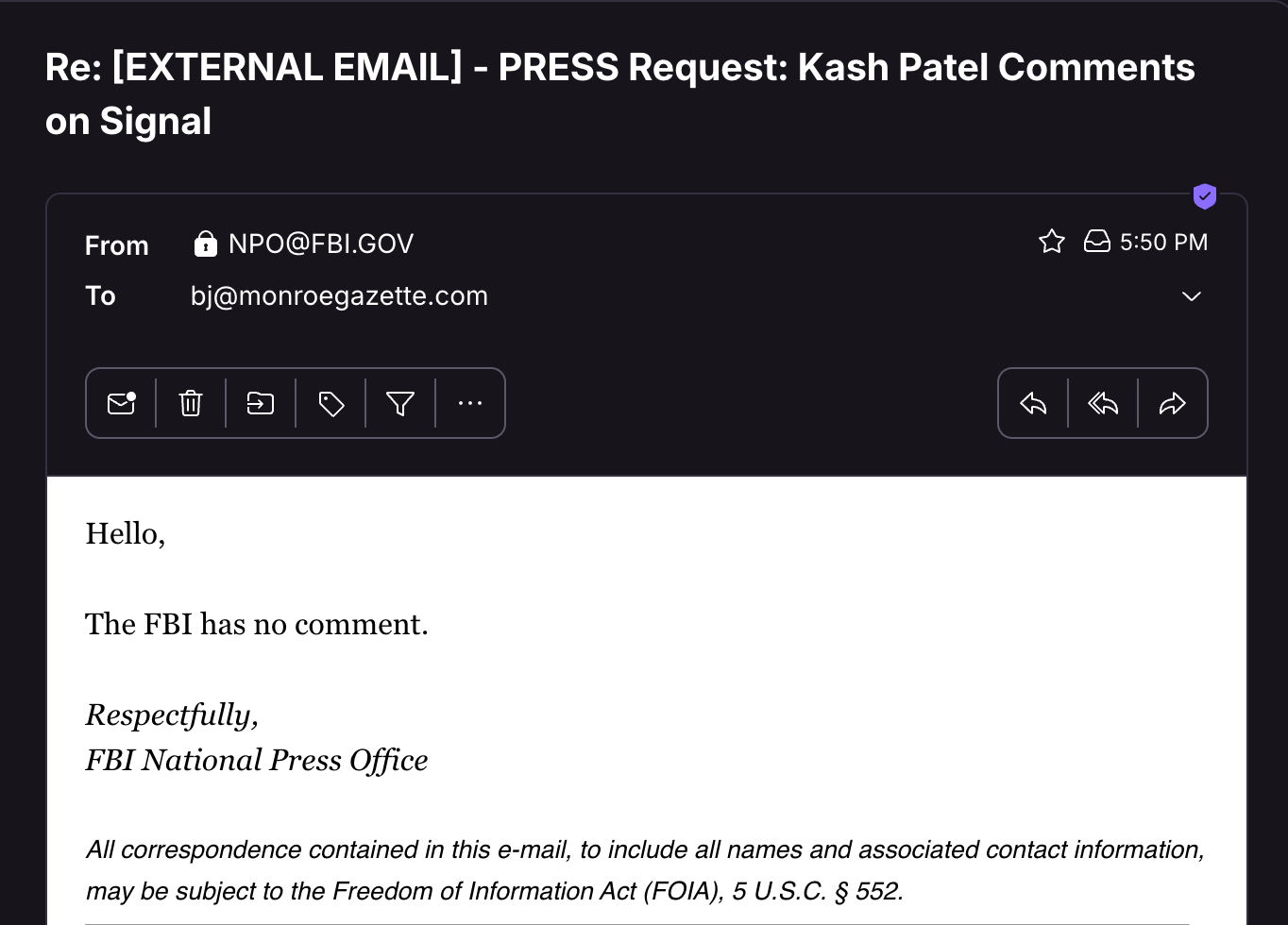
So, I wrote to the FBI's Public Affairs Officer for comment on what exactly the FBI would be investigating, because in the United States, it is safe and legal to use Signal.
It is safe and legal to discuss publicly available information, such as the license plates used by ICE officers in their often-rented vehicles for the purposes of maintaining your personal safety and the safety of your neighbors.
After all, most of America just saw a man gunned down in cold blood by these ICE and Border Patrol officers. (People are referring to the collection of federal agents and agencies participating in these raids as ICE, despite them being part of different organizations.)
It is also safe and legal to discuss publicly available information about ICE agents, such as Renee Good's alleged killer, Jonathan Ross. This is no different than the Right Wing Goon Squad "discussing," or doxxing people, and costing those people their jobs, for making negative comments about Charlie Kirk after he was murdered. Somehow, Kash Patel couldn't be bothered to document and act on much of that literal harassment. But he's got time for this, right? Funny how that works.
I will update this post if the FBI messages me back. They’re usually pretty good about getting back to me. I also have to say that over the years, I've had positive interactions with the FBI agents I’ve encountered as part of my duties as an investigative reporter. It's hard to believe any of them would justify or support Patel's statements. If some of the recent whistleblower accounts are anything to go by, most of them don’t.
And, as you know, unlike WhatsApp, Signal isn't compromised by the very people who own and operate it the way Meta can and has compromised WhatsApp when asked. We also reached out to the Signal Foundation to respond to Kash Patel's comments, as well as our friends at the ACLU and a couple of First Amendment experts. So, I am hopeful that in the coming weeks, we’ll have something meatier to share with you on this story beyond my blabbering.
Updated:
Here's the FBI's official comment on the matter:
Yes. You Can Keep Using Signal
For now, I want to reiterate that Signal is safe to use. Yes, there are other encrypted messaging apps out there. In fact, some of them are much better than Signal.
However, from my experience organizing volunteer efforts and activists, I know that many people struggle to use their messaging apps and all their features. So, when you tell them to download a whole new messaging app, it’s incredibly daunting to get them to make the switch and then commit to it. It's easy for the more tech-savvy among us to roll their eyes at this, but I've found it repeatedly to be the truth among both the young and the old. Don't assume people know how to use their smartphones to the fullest. Most don't.
Sometimes, people will switch to something like Signal and then revert because most of their friends and family haven't made the switch. This is incredibly frustrating and very common. What is attractive about Signal is that, among all the options for encrypted messaging, it’s the most user-friendly and has features that people like to use. So if you think about things in terms of probability, like I do, the probability that someone adapts to using Signal is way higher than the probability that they adapt to using something like Wire.
I have found a couple of great resources for fellow activists—which, honestly, should be every American right now—that I'll link to here. The first is Micah Lee's Using Signal Groups for Activism, which I found to be really helpful. (As much as I like to think I know things, I learned a lot from Micah's list.) I also found this page on the Activist Checklist to be very helpful in getting people set up properly once they've safely transitioned to using the Signal ecosystem.
One thing I will say, and this has been noted by smarter people, is that if you're going to use Signal for group messaging, there are some things you want to watch out for. First, you need to make sure you know who everyone in the group is. As your group grows, the odds increase that not everyone entering it has the best of intentions.
I've seen, for example—and this isn't a Signal-specific issue, just an activist issue—that in Zoom meetings for groups like Indivisible Rockland, there are absolutely people looking to screenshot discussions or take clips just to create content for the far-right grievance machine (Twitter, Fox News, Breitbart, etc.). And it's not just them you need to watch out for, but potential ICE agents as well.
You are better off keeping your Signal groups to fewer than ten people if they are working groups. Meaning, you're discussing actual tactics that are specific and time bound.
If, for some reason, you're in a large Signal group like the one I'm currently in about the local concentration camp, my recommendation would be to switch to something like Element (an encrypted, more secure alternative to Slack).
Put another way, if you don't know the organizer of a Signal group that you're in, or there are a flood of people that you're not familiar with into that group, you might want to consider leaving it asap.
One other thing I want to recommend regarding Signal is this: if you can afford it—and not everyone can—but if you can, we suggest getting an inexpensive secondary phone with a prepaid number and account via Mint Mobile. (It doesn't have to be Mint Mobile for those of you who want to boycott T-Mobile due to their ties to the regime.) Once you've set up that new phone number, you can then use it to create a free Google Voice number. That Google Voice number can be used to set up your Signal account. DO NOT USE YOUR REAL NUMBER WHEN SETTING UP SIGNAL IF AT ALL POSSIBLE.
If you do end up using your phone number, it happens—like I said, just getting people to switch from their messaging app to Signal is a much bigger lift than most think it is—so make sure to go into your settings, enable usernames, and hide your phone number. This is one way to help protect yourself. As always, when it comes to matters of money, do what you can when you can. No one is judging or rushing you. These tips are meant to help keep you safe. That secondary phone will also come in handy if you're planning on attending a protest. It's best not to bring your actual phone with all it's data. Actually, I prefer you go with no phone at all, and carpool to make it harder for ICE to identify and harass you later, but your mileage may vary. (If you go without a phone, make sure to write an attorney's number or the number of another legal aid organization on your arm in black marker. They used to do this at Vietnam protests, and it’s probably time to bring that trend back since the more data someone can collect on you, the more effectively they can harass you.)
How to Film ICE
Before we close, I want to remind you about your rights when filming ICE. I’m not a lawyer, and I’m not your lawyer. The situation can change based on the jurisdiction you’re in, so make sure you’re familiar with your local rules and regulations before taking out your phone to film.
First, you can and should absolutely film them at all times and all opportunities. The thing is, you gotta stay out of their way. If there are directives to stand on a certain street or a certain distance, you have to follow that. How do you know if you are "far enough?" If the ICE agent needs to take multiple steps just to get to you, you're far enough. (If you want a sports analogy, think of the distance between the pitcher on the mound and the hitter, not the hitter and the umpire in a baseball game.)
You also have to understand, as we saw with Renee Good and Alex Pretti, there's a risk involved in filming ICE. They can hurt you. They have hurt others. If you choose to film them, you are — first and foremost, you're a hero in our book — but secondly, you are also acknowledging the potential for danger. We can't legally tell you to film them for that reason. It's up to you to do so. If they get violent, your job is to remain calm and quiet. Again, do not escalate. Let the video and audio speak for itself.
On that front, if you do choose to film ICE, it's important to remain calm, do not escalate, and don't make any sudden movements. Be still. Be quiet. Keep your voice low. Phones can be confused for weapons, and in the heat of the moment, if you have a black phone and an under trained white supremacist with a gun near you, they could shoot you. If you have a black phone, we recommend getting a pink case or otherwise noticeable color to prevent it from being confused with a weapon.
When filming ICE, you want to capture their badges, uniforms, license plates, cameras, and their body cameras (if any) as well as any other details you can observe. If you're at a good enough distance—like if they told you to move back a block—this is a good time to provide specific information in your video, such as your location, the number of agents, their badge numbers, and anything else relevant. Don’t ramble. Be clear and specific. Think: What information will be needed in court? Stick to the facts.
Don’t assume anything. Don’t record yourself making assumptions about anything, as anything involving an arrest you’re filming is admissible in court.
If you choose to film, make sure not to reveal the identity of the person being kidnapped. Don't film anything that could be used to identify them for retaliation like their apartment number. If you film you can tell people the general vicinity that you're in, look for familiar landmarks and buildings.
If you are able, ask the person being kidnapped what they need or how you can help them. If that person asks you to stop filming, follow their directions. Their safety and dignity are your top priority. We film to protect them. Don't do anything that would harm them or yourself. You can remind the person being detained of their right to remain silent and right not to sign any documents ICE puts in front of them.
One of the reasons we recommend using a secondary device is that ICE could demand to search your phone if you're filming them. The whole point of the secondary phone is to limit the contents that are on it. You are under no obligation to unlock your phone without a warrant (just make sure you're not using biometrics to unlock your phone like your thumb or face, which makes it easier to unlock your device. Always use a long pin.)
Given how violent and irrational ICE agents are behaving, don't fight them if they want to take your phone. Get the officer's name, badge, and tell them you do not consent to them taking your phone. If they tell you to stop filming, simply say you are exercising your first amendment right to document their activity.
If you are going to film ICE, make sure you've enabled automatic backup of your videos to Proton Drive. Do not alter the name or anything about this file. Do not trust Google or Apple with your files either. Proton Drive is the way to go.
If you're going to make an edit or add something like captions, make a copy first of the original video. Do not edit the original.
If you're going to share the video on social media, as a lot of Rapid Response groups do when they spot ICE, just be aware that anyone can see who's sharing that video, and it may have consequences for you down the road. Share first with people that you trust and people who can help before you share with the public.
We're going to focus a bit on Signal in the upcoming episodes of Privacy Tips just to help people get more comfortable and familiar with using it. If you want to reach out with any additional tips or opinions, you can find me there at bjmendelson.32
Until then, stay safe, and we'll see you soon with another episode of Stupid Sexy Privacy.


